Notes

Land of the Sky Tournament information can be found by clicking on the button above.

Newcomers to the site should note the pickleball book "chapters" in the left column and the repository of expert articles and videos in the right column.
Showing posts with label Position. Show all posts

Tuesday, June 5, 2018

Lean In

Getting the fundamentals right...

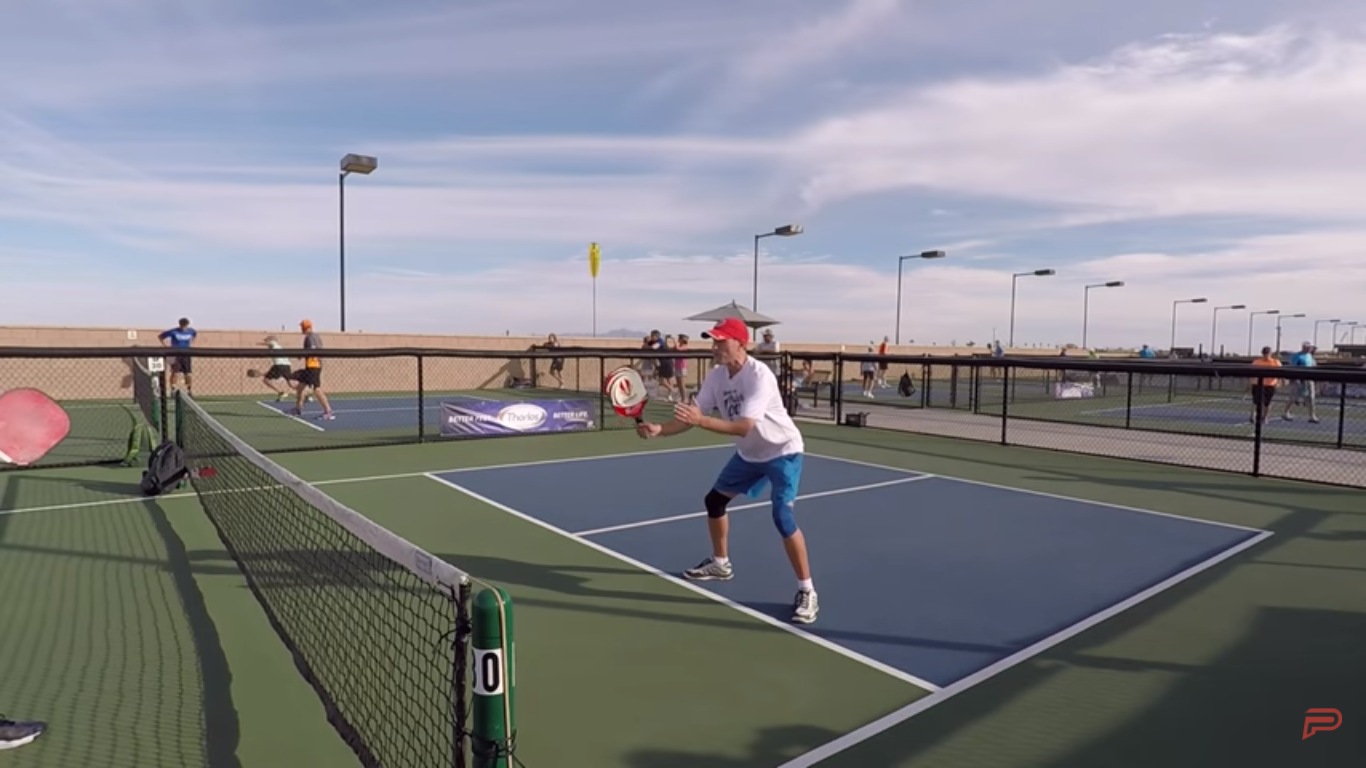
Guest Dave Weinbach is back in this week's Jordan Briones Primetime video, with another tip about play at the NVZ line. The video is titled Offensive NVZ Line Positioning with Dave Weinbach.

The focus of Dave's message is how a player should be positioned at the NVZ line. First, he states that players should be right at the line. His feet position in the video show him with nearly no gap between his toes and the line. Second, Dave wants players to lean forward. His positioning shows a slight knee bend for balance, bending forward at the waist, and extending his arms.


Thursday, May 10, 2018

The Myth of Sides

"I'll Take Everything on My Side"...

DJ Howard's tip this week is about court coverage and communication. These are two topics that have been discussed a lot here but a new perspective is always welcome.


Myth - "I have my side, you have your side."

There are two sides of the court, but that does not mean each player ought to cover precisely one half of the court. On the contrary, all things being equal, there ought to be overlap over the center by each player. Since all things are NOT equal, each player's positions should shift left or right along with the location of the ball on the other side of the net, meaning the center line is no longer the middle of the two players. The middle of a doubles team is NOT the center line most of the time.


Sunday, April 22, 2018

Recycle Sunday - Moving as a Team - Let's Stay Together

A blast from the past...

This week's Recycle Sunday article was originally published January 14, 2016.

***


Everyone has heard the saying "Two heads are better than one". In pickleball, two players are better than one...if they play as a team. Pickleball is a game of quick shots and strategy. A team must be properly positioned to to account for both factors in order to maximize the probability of winning a rally.

Before beginning the discussion of team positioning, let's review the court dimensions.

Tuesday, March 20, 2018

Third Shot Footwork

Getting the fundamentals right...

The Jordan Briones Primetime video series continues from a different position - the baseline. Today's post uses his video Pickleball | Essential 3rd Shot Footwork to show how proper positioning will help to make your third shot drop more consistent

The fundamentals of any consistent shot, especially the third shot drop, consist of hitting the ball in the same place every time. I talked about this extensively in the December 16, 2017 post Positioning and the Natural Swing. I stated:
I believe that everyone has a natural swing. The swing that you took the first time you touched a paddle was likely your natural swing. You performed it without thought and used what felt comfortable. Ever since that day, your swing has been influenced by your mind as it adjusts your swing to fix mishits and misplays and to add others' technical advice...
The principle of a natural swing is simple. It is all about comfort zones - something I have talked a lot about in this blog, especially when targeting spots to take your opponents out of their comfort zone. The same theory can be reversed when thinking of yourself. Getting yourself into a position to take your natural swing is the ultimate comfort zone. That's a place you want to be.
Jordan talks about hitting the drop shot in your comfort zone, i.e., not reaching and not allowing the ball to get too close to your body. It is the area when you are balanced and most in control. In order to always contact the ball at the same point, it is imperative that you move your body to the proper position. This takes anticipating the ball's path and and getting your feet positioned early.


Tuesday, March 6, 2018

More on Positioning at the NVZ Line

Getting the fundamentals right...

The next video in Jordan Briones Primetime video series follows up on the post from 2 weeks ago called Fundamental Positioning at the NVZ Line. That video discussed "depth", meaning distance from the NVZ line. This video literally changes direction to discuss positioning and footwork side-to-side at the Non-Volley Zone line. The video is titled Pickleball Footwork | Winning Footwork At The Net

Jordan's main point on positioning is that players should be in the middle of their half of the court, i.e., nearly equidistant from the center line and the sideline.


Tuesday, February 20, 2018

Fundamental Positioning at the NVZ Line

Getting the fundamentals right...

The Jordan Briones Primetime video series continues with fundamental advice. Today's post uses his video Pickleball | How To Dominate The Net to discuss positioning and footwork at the Non-Volley Zone line.

The discussion is focused on techniques after all players are established at the NVZ. There are 2 main concepts to remember. Each is discussed below.

1. Establish yourself right at the line. Not a foot back. Not even 6 inches away. Right at the line.


Saturday, December 16, 2017

Positioning and the Natural Swing

The more disciplined you become, the easier pickleball gets...

Back in October, I wrote a post I thought was one of my most important. It was titled Pickleball PEP Talk - the Keys to Success and was intended to boil success down to its 3 most essential elements. PEP was an acronym for Positioning, Execution, and Patience. Today's post will expand on Positioning. But first, let's revisit that segment from the October article.


Positioning

Positioning primarily refers to two issues - being in the right place on the court and getting your feet/body in the right place to hit the shot. Being in the right position on the court demands an understanding of several strategies including:

Friday, December 1, 2017

Re-learning Movement at the NVZ

Learning something new pushes something old out of my brain...

When I started this blog, one objective was to chronicle my path of learning the game. I have tried to do that even as the learning has slowed. Today is another one of those educational experiences. 

I have been working with a friend to help become more consistent at dinking. I am fairly good at dinking balls that have a normal bounce and dinking balls that I can take in the air. (That is a secret I will discuss on another day.) I can also hold my own on harder, penetrating dinks at my feet or to my paddle hand side. My struggles are with the hard and low crosscourt dink to my backhand side, especially when forced to move a couple steps from near the centerline.

The first training videos I watched to learn the game were from Coach Mo. He had a video about moving at the NVZ line in which he showed a crossover step to extend a player's reach. A screen capture from his video is shown below.


Thursday, July 20, 2017

SE Regional Ambassador Retreat - Balance

The mountains are calling and I must go...

I have previously mentioned that a group of 41 USAPA ambassadors plus guests recently held a 3+ day retreat at the Beech Mountain Club. The retreat consisted of various learning sessions, one of which was about balance. Sharon Mackenzie gave the presentation based on her experiences with physical education and play in her area. Sharon's handout is shown below. Her handiwork and advice is exactly what is needed after our discussions the past couple of weeks.


Proposal to the USAPA and USAPA Ambassadors

To encourage Ambassadors to alter the skill progression they use teaching Pickleball in their newbie clinics, especially to seniors.

Wednesday, July 19, 2017

Balance

Stability is everything. You need a solid base to build on...

In this series on movement around the court, one term is mentioned again and again - balance. 

In How Golf Relates to Pickleball, I stated that positioning of the feet is important because "It puts the player into a balanced position. This provides more options for the player to make better shots."

In Speed Kills, Sarah Ansboury is quoted as saying "Rather than focusing on “getting to the ball”, I want you to focus on being in control.  I want you to be balanced."

In Split Step Timing, I stated "This allows me to more easily stop by planting my feet in a balanced position before hopping and pushing off for the next shot." 

In NVZ Footwork, I discussed Mark Renneson's movement as "Movement quickens the reaction to move to the next shot and allows for getting the body positioned for consistent shots by being balanced."  That post also included a description of Deb Harrison's techniques, stating "She emphasizes quick movements so the shot can be made from a balanced position without rushing it."


Tuesday, July 18, 2017

Pro Footwork at the NVZ Line

The kitchen is not for dancing...


Today's post is short and sweet - just like NVZ line movements. Yesterday, we discussed 2 alternative views from experts. Today, we will watch 4 pros in action. Focus on their footwork. The video comes from Poach PB and is called Pickleball Kitchen View.


Note that the foot movements are short and quick with calm between shots. The movement shown by these players is typical of top level players and aligns with Deb Harrison's techniques shown yesterday. The quick movement gets the body positioned for a smooth balanced shot.


Monday, July 17, 2017

NVZ Footwork

The kitchen is not for dancing...

Let's continue our series on court movement. Last week we covered moving through no man's land to get to the NVZ line. The need to move does not end when the NVZ line court position goal is attained. It just changes. Instead of long strides and moving forward, NVZ line movement becomes side to side or quick steps forward and backward. This another topic that has been covered extensively and past articles can be found in Chapter 6: NVZ Play - The Dink. We will try to bring some new ideas to the discussion.

Mark Renneson's video Advanced Footwork at the NVZ provides his thoughts on the perpetual motion machine that players should become. He demonstrates a string of dinks while keeping his feet constantly moving through hops and shifts. Mark's theory is sound. It aligns with the science discussed by the Auburn softball team in Optimal Reaction. Movement quickens the reaction to move to the next shot and allows for getting the body positioned for consistent shots by being balanced. Images cannot capture the dynamism of Mark's presentation. Watch the video before we move on.


Saturday, July 15, 2017

Optimal Reaction

Hops aren't only for beer...

We ended yesterday's post about split step timing with a question - why bother to hop? After all, can't a player just move toward the ball from the ready position?

Obviously, the answer to the second question is yes, a player can simply step out of the ready position to make a return. But, the answer to the first question comes from science and it says that optimal reaction is created by using a hop.


The split step and, therefore, the hop comes from tennis. But it isn't the only sport that uses it. The women's softball team at Auburn University has looked at the science and uses it extensively in their play. As explained in the below video called Auburn Softball: On the Hop, the hop takes the slack out the muscles and allows them to fire in a "more aggressive purposeful ballistic motion". Its essence is that reaction time is reduced - especially first step reaction time. 

Friday, July 14, 2017

Split Step Timing

Its not the situation. Its your reaction to the situation...

We have been talking about movement and, more specifically, about movement from the baseline toward the NVZ line. A fundamental of this movement is the split step. This technique transitions a player from forward movement to the ready position and then toward his next return. 

We certainly have not ignored the split step in our discussions. It is highlighted in Chapter 5 - Earn the Net and mentioned frequently in many other posts. Many of those posts were written early in my playing and learning experience and relied on some old-school advice about the timing. Generally, players were taught to stop and split step just prior to the instant when the opponent was striking the ball. 


Thursday, July 13, 2017

Speed Kills

I feel the need, the need for speed...

Today's post will continue the series on court movement with further discussion of the first big move - getting to the NVZ line. We have discussed this extensively in prior posts and I won't repeat much of that. Please refer to the Positioning and Footwork section of Chapter 5 - Earn the Net. Instead, we will focus on some new perspectives that I have gained in my learning curve - both on the court and from the experts.

We've all seen the guy that hits a ball from the baseline and races forward to get to the NVZ for his next shot. Sometimes it works. Other times the player is unable to change direction or adjust his next hit to account for the momentum of his body. Players race forward in obeisance to the pickleball gods # 1 mantra - "GET TO THE NET". But watching the pros and other high-level players will show that is not how it should be done. Instead, they move forward at a pace that keeps them on balance and under control.


Sarah Ansboury wrote 3 posts for the RV Picklers blog that discussed her observations of recreational play. One of those posts discussed the need to slow down. Relevant excerpts of the post are shown below. The entire post can be read at Pickleball Observations #2: Slow Down, Stop Shuffling.
The Slowest Player on the Court
When I join in during recreational play, I often am the slowest person on the court. Everyone seems to be in such a hurry!  They scurry from side to side, running to one spot while leaving another open.  They lunge forward, head first and paddle last, trying to get to the non-volley zone line.
Their movements are exacerbated by what we talked about last week…bending over.  The average human head weighs more than ten pounds, so it is only natural when we bend our backs and lead with our heads that we will be pulled off-balance and out of position.  If you are leaning left and then need to move right, the weight of your head pulling in one direction will make it more difficult to react.
Rather than focusing on “getting to the ball”, I want you to focus on being in control.  I want you to be balanced.  Instead, focus on what you want to do with the ball.

Saturday, July 8, 2017

How Golf Relates to Pickleball

Balance is not something you stumble across.  It is something you create...

I mentioned golf in yesterday's post about movement. The statement was:

"I like to talk about golf when explaining this concept in clinics. Golfers practice the mechanics of the swing hour after hour to build the muscle memory to repeat it on the course. But the ball must be in the same place relative to their body to make the same swing. Therefore, they adjust their body by bending at the knees or or waist in order to play a ball on a slope or otherwise impaired."

Today, I would like to expand on that relationship. First, I want to use a Mark Renneson video called Golf vs Pickleball. Mark's emphasis in this video is about the power generated when a player loads up by "coiling" his body. The power behind a shot is released when the body "uncoils" during the swing. While that is an excellent concept to understand, it is not how I want to use this video. Mark briefly mentions getting into the proper position and I want to explore that more in-depth.


Friday, July 7, 2017

Movement Around the Court

Preparation requires awareness and movement...


The single most important element in becoming a better player is proper movement around the court. That means a lot of things and we will start a series of posts that cover much of the topic. Today, I want to start with early preparation, which means moving to the proper position to make the best shot...and nothing is more important at that instant.

Last October, I wrote a post - The Most Important Shot - in which I stated the most important shot is the next one. The basis for that statement is summed up in the following:
The only time that you control the rally is when the ball is on your side of the court. Therefore, your next shot will always determine how the rest of the rally will play out. A good next shot increases the probability of winning the rally and a bad next shot decreases that probability. In other words, your next shot is the best immediate opportunity to gain an advantage.
The post goes on to talk about footwork and positioning as key to making the best shot:

  • Take the extra step to be in a better position
  • Stop before hitting the ball

Friday, April 7, 2017

Reinventing my Game - Progress Exposes another Dink Problem

Change is hard, then messy, then good...then messy again...

A couple of weeks ago I wrote a post - Reinventing My Game - A Temporary Setback - in which I discussed my failure to bend to make a dink or low volley was causing me to pop the ball up. That knowledge allowed me to fix that problem immediately and I have not had a problem since. Now it is time for me to bare my soul and discuss a follow-up problem.

Once I determined that my basic dinking was acceptable, I wanted to move to the next step and become a more aggressive dinker. I started drilling with better players willing to help me. That meant they were dinking more aggressively to me - with more pace at or near my feet. Suddenly I had the opposite problem than my previous setback - I was either hitting the ball into the net or wildly out of control. I even hit my foot with the paddle more than I care to admit.

That last little tidbit should been the clue that gave away my problem, but I can be a a tad obtuse when I have to think about my own play. Her is a hint of my problem.


Tuesday, April 4, 2017

Team Movement on a Defensive Lob

See a gap, fill it...

The act of retrieving an opponent's lob and hitting a defensive lob is probably the single play that requires the most adjustment by the retriever's partner. Retrieving a lob almost always pulls at least one player out of position. It is up to the partner to compensate by filling the hole created by the retriever. Mark Rennesson discusses this concept in his video Be Better Handling Lobs.

Mark uses two different teams in identical situations to illustrate the idea of filling the gap. The first is a pro team and the second is a less knowledgeable team. In both cases, the opponent's lob is made over the female partner's head when she is on the right side of the court. The male partner hustles back to make a defensive shot. In the case of the pros, the female partner watches the male player's movement and moves across the court to fill the hole vacated by her partner. This is illustrated in the sequence of 3 photos shown below.


Tuesday, March 14, 2017

Defend the Line

You have to defend your honor, your family, and the NVZ line...

Over the last week, I highlighted the importance of teaching from the NVZ as the first step and focused on that with drills to make players more comfortable at the NVZ. Sarah Ansboury's article for the RV Picklers adds to the power of that position.


What is so important about holding your line? Everything! Pickleball is played at the non-volley zone line. If you are not positioned at the non-volley zone line for the majority of the game, you are playing a different game.


Getting There

The first step to holding the line is to get there. If you don’t get to the non-volley zone you will not improve. If you have mobility challenges, consider hitting a high, loopy service return rather than driving the ball. Hitting a high, deep return gives you more time to move to the line. There are many players that have perfected this shot and can actually walk to the line. Consider using the line as a guide. If you are properly positioned at the non-volley zone, your paddle will be extended over the non-volley zone in front of you.